

Imagine walking up to a postal counter with a package containing a few bricks. Strange, but possible. Now add a crate of live animals. Things are getting complicated. Finally, take your young child by the hand and ask how much postage it would cost to send her to Grandma. For a brief and wonderfully chaotic period of American postal history, that last question was not entirely hypothetical. When Parcel Post arrived in 1913, Americans immediately began testing what the new service could carry, sometimes discovering possibilities its creators had clearly not anticipated. Farms, homes, construction projects, valuable objects, food, and even a few human passengers became connected by stamps and mail routes in ways that seem almost impossible today. So decide what you would accept at the counter, then see what American postal workers actually had to handle.
#1: Babies Were Briefly Sent by Parcel Post
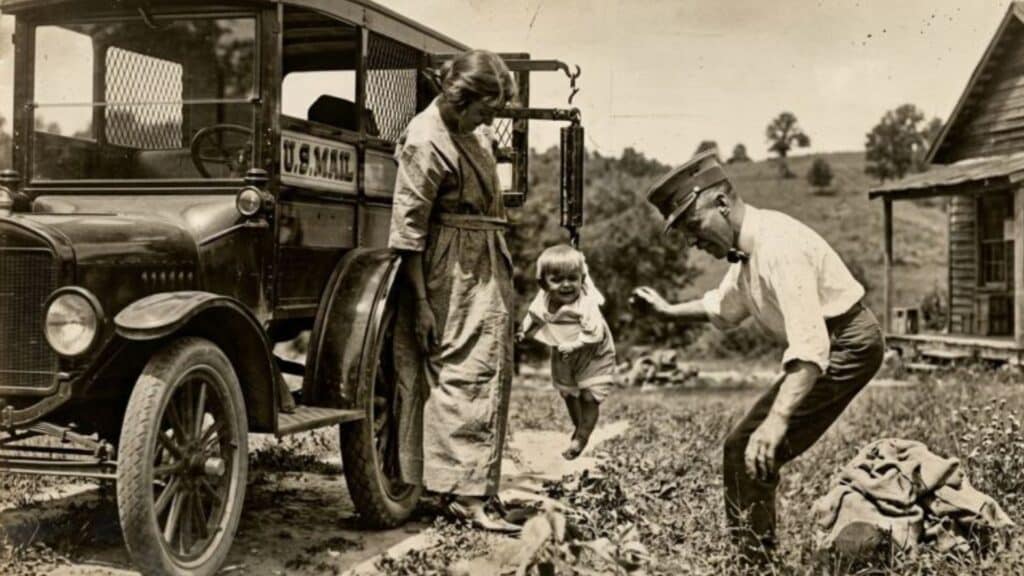
One of the strangest consequences of the United States introducing Parcel Post in 1913 was that a few parents discovered the new regulations did not explicitly say that children could not be mailed. Within weeks, newspapers reported the case of an Ohio couple who entrusted their infant son to a rural mail carrier for delivery to his grandmother about a mile away. The child reportedly weighed just under the Parcel Post limit, and his parents paid 15 cents in postage while insuring him for $50. This was not the beginning of an official baby-delivery service, and infants were certainly not being packed into cardboard boxes and thrown into mail sacks. Rural carriers were often familiar members of their communities, which helps explain how such an arrangement could seem less reckless to participants than it sounds today. Nevertheless, several similar cases followed as families exploited the novelty and ambiguity surrounding the new system. Postal authorities eventually made it explicit that human beings were not acceptable parcels.